You're doubled over, gripping your stomach.
“Please hold.”
Elevator music. A stranger who'll read your fax in three weeks. Nobody who can tell you what it'll cost. Meridian ends the hold music: it answers, triages you against real clinical evidence, books the scope, and fights the insurance company — a human signs every step, and it never diagnoses.
The stakes
colorectal cancers in adults under 50 are caught late — it's now the #1 cancer killer under 50, rising 3% a year.
average wait just to see a gastroenterologist — the longest of any specialty in America.
what a practice pays, on average, when a missed colorectal cancer becomes a malpractice claim — and two-thirds of referrals never even become completed visits.
Today
This is the current system, working as designed.
Without Meridian
- Your referral is a fax in a tray. Someone keys it in on day 3.
- Weeks of phone tag — 40 days on average before a GI even sees you.
- Prior auth: 24 minutes of staff hold time per case, weeks on the calendar.
- Your cost? Nobody can tell you until the bill arrives.
- Two-thirds of referrals never become completed visits at all.
With Meridian
- The call is answered now; the fax is read in seconds.
- Triage in under a second, against cited clinical evidence.
- A nurse signs; the slot books straight onto the calendar.
- Insurance matched up front: prior auth flagged, your rough share shown.
- The agent drafts the paperwork and sits through the hold music.
Meridian
The AI front desk for GI practices — every referral becomes a booked, authorized procedure.
GI practices & MSOs
buy it — recovered referrals are four-figure procedures they already own.
Triage nurses & schedulers
run it — same queue, same sign-offs, without the fax pile and the hold music.
Referring physicians
trust it — the loop closes the same day, with an audit trail on every decision.
How it works
AI reads. Rules decide. People sign.
Five steps, five partners — each one doing a job the demo would die without.
A call or a fax arrives
Patients talk to a live voice agent (ElevenLabs). Faxes are opened inside a throwaway, internet-blocked sandbox (Daytona) that's destroyed seconds later — hostile documents never touch the system.
AI reads it — facts only
Fireworks extracts age, symptoms, duration, insurance — in about a second, with a per-field confidence score that corroborates our deterministic transcript parser; low confidence fails to a human, never to a guess. Small, fast open models targeted per input type, called statelessly so no patient text sits in a model provider's records — and we raced two of them, scorecard attached.
Rules set how fast
Ten auditable rules, thresholds measured on 2,093 real patients, cited line by line. Braintrust grades the system on every change and traces every live decision — 100% of urgent cases caught.
A nurse clicks approve
The copilot drafts the calendar event and the Slack note to the care team; the nurse clicks send. The slot books with the patient's estimated cost already shown.
The paperwork fights itself
Prior auth drafts with every sentence sourced. The doctor signs. The agent dials the payer's phone tree (ElevenLabs voice) and sits through the hold music — every step leaves a replayable trace.
One system, two doors
For the patient
Call. Answer. Pick a slot.
- Talk to the intake line — live voice, no hold music.
- Evidence-based questions: symptoms, history, insurance.
- See nearby options with your estimated cost, before you hang up.
Try the patient side →
For the clinic
A queue that argues its case.
- Every verdict shows the rule that fired and the study behind it.
- Insurance matched, prior auth drafted, payer chased.
- A copilot explains verdicts; Slack + calendar notes draft themselves.
- Nothing books or sends without a named human's signature.
Open the clinic side →
How we triage — one real case
Every verdict is a receipt, not a vibe.
1Facts extracted
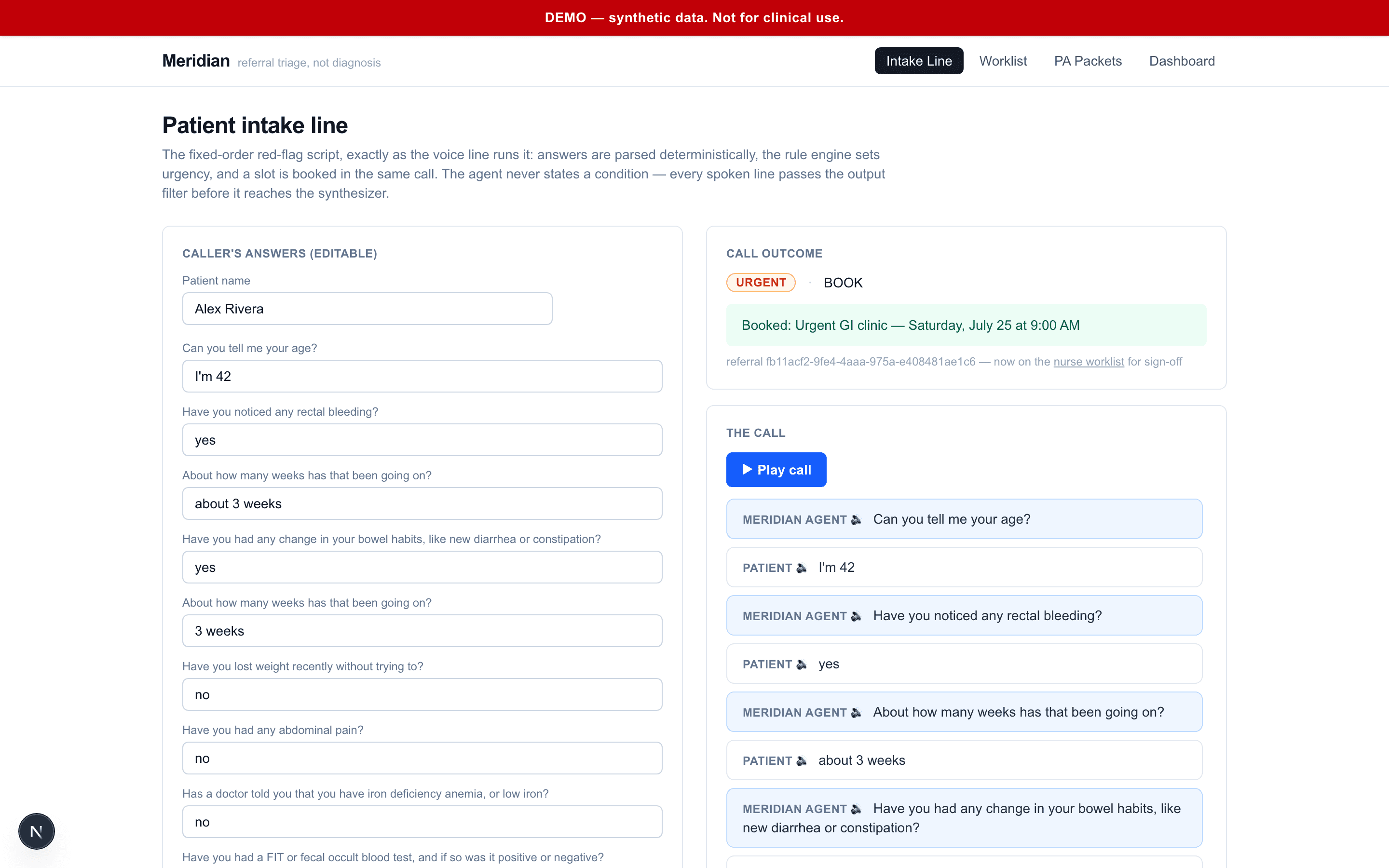
Age 42 · rectal bleeding, 3 weeks · change in bowel habit. The AI reads; it adds nothing.
2Rule fired
Under 50 + bleeding + a second red flag → URGENT. Threshold measured on 2,093 real patients (Hamilton 2005; NICE NG12) — the citation shows in the app.
3Fail-safe
Anything missing or unclear routes to a human. There is no code path that tells a patient they're fine.
4Insurance matched
Plan identified · prior auth required → packet drafts itself · estimated patient share shown up front. Coverage can never change urgency — money never outranks medicine.
5Human signs
Nurse approves → the slot books to the calendar and the care team gets a Slack note the copilot drafted (output-filtered, like everything else). Physician approves → prior auth goes out, and the agent chases the payer by phone.
See it
The call ends with an appointment.
Why trust it
100%
of urgent cases flagged in testing — and zero patients falsely told they're fine.
2,093
real patients behind the thresholds (Hamilton 2005; NICE) — every rule cites its study, inside the product.
<1s
from arrival to a cited triage verdict — against an industry baseline measured in days on a fax pile.
We don't diagnose anyone.
We make sure the right people get scoped.